RMgmDB - Rodent Malaria genetically modified Parasites

SummaryRMgm-516
|
||||||||||
 *RMgm-516
| Successful modification | The parasite was generated by the genetic modification |
| The mutant contains the following genetic modification(s) | Gene disruption, Introduction of a transgene |
| Reference (PubMed-PMID number) |
Reference 1 (PMID number) : 21625527 |
| MR4 number | |
| top of page | |
| Parent parasite used to introduce the genetic modification | |
| Rodent Malaria Parasite | P. berghei |
| Parent strain/line | P. berghei ANKA |
| Name parent line/clone | P. berghei ANKA 507cl1 (RMgm-7) |
| Other information parent line | RMgm-7 is a P.berghei ANKA line (507cl1) which expresses GFP under control of a constitutive promoter (PubMed: PMID: 16242190). |
| top of page | |
| The mutant parasite was generated by | |
| Name PI/Researcher | C.S.S Gomes-Santos; J.A.M. Braks: G.R. Mair |
| Name Group/Department | Malaria Unit |
| Name Institute | Instituto de Medicina Molecular |
| City | Lisbon |
| Country | Portugal |
| top of page | |
| Name of the mutant parasite | |
| RMgm number | RMgm-516 |
| Principal name | 1267cl2 |
| Alternative name | Pbpuf2-KOb |
| Standardized name | |
| Is the mutant parasite cloned after genetic modification | Yes |
| top of page | |
| Phenotype | |
| Asexual blood stage | Not different from wild type |
| Gametocyte/Gamete | Not different from wild type |
| Fertilization and ookinete | Not different from wild type |
| Oocyst | Not different from wild type |
| Sporozoite | Normal numbers of oocysts and salivary gland sporozoites are formed. Sporozoites are defective in gliding motility and hepatocyte cell traversal in vitro (see also 'Additional remarks phenotype' for further description of the sporozoites). Sporozoites are less infective to hepatocytes in vitro and to mice after intravenous inoculation of sporozoites. Sporozoites could not be transmitted to naive mice by mosquito bite. |
| Liver stage | Normal numbers of oocysts and salivary gland sporozoites are formed. Sporozoites are defective in gliding motility and hepatocyte cell traversal in vitro. Sporozoites are less infective to hepatocytes in vitro and to mice after intravenous inoculation of sporozoites. Sporozoites could not be transmitted to naive mice by mosquito bite. |
| Additional remarks phenotype | Mutant/mutation Evidence is presented that sporozoites in the absence of Puf2 'prematurely' initiate development into the early livers stage (EEF's) inside salivary glands. This is based on morphological changes of sporozoites in salivary glands, at day 18-27after mosquito infection, resembling transformation of sporozoites into the early liver stage after hepatocyte invasion and on genome-wide transcriptional changes in sporozoites that accompany the morphological changes. In P. falciparum Puf2 expression has been demonstrated in gametocytes and disruption of Pfpuf2 (PFD0825c) resulted in increased gametocyte production and increased differentiation of male gametocytes (Miao J. et al., 2010, 123-1039-1049). The phenotype of the P. falciparum mutants lacking expression of Puf2 has not been analysed during mosquito development. See mutants RMgm-513 and RMgm-514 lacking expression of Puf1 ((PBANKA_123350) . Phenotype analyses of these mutants indicate that Puf1 is not essential for blood stage development, production of gametocytes, ookinetes, oocysts and infective sporozoites and for mosquito transmission and liver stage development . Mutant RMgm-591 that lacks expression of both Puf1 and Puf2 shows the same phenotype as mutants lacking only expression of Puf2. Other mutants |
Disrupted: Mutant parasite with a disrupted gene| top of page | |||||||||||||||||||||||||
| Details of the target gene | |||||||||||||||||||||||||
| Gene Model of Rodent Parasite | PBANKA_0719200 | ||||||||||||||||||||||||
| Gene Model P. falciparum ortholog | PF3D7_0417100 | ||||||||||||||||||||||||
| Gene product | mRNA-binding protein PUF2 | ||||||||||||||||||||||||
| Gene product: Alternative name | Pumilio2 | ||||||||||||||||||||||||
| top of page | |||||||||||||||||||||||||
| Details of the genetic modification | |||||||||||||||||||||||||
| Inducable system used | No | ||||||||||||||||||||||||
| Additional remarks inducable system | |||||||||||||||||||||||||
| Type of plasmid/construct used | Plasmid double cross-over | ||||||||||||||||||||||||
| PlasmoGEM (Sanger) construct/vector used | No | ||||||||||||||||||||||||
| Modified PlasmoGEM construct/vector used | No | ||||||||||||||||||||||||
| Plasmid/construct map |
  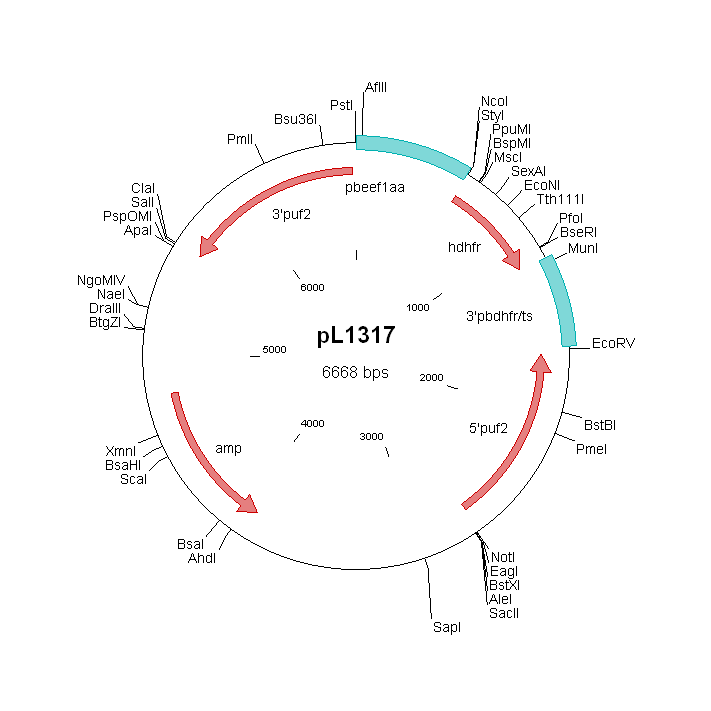
| ||||||||||||||||||||||||
| Plasmid/construct sequence |
GCCCAGCTTAATTCTTTTCGAGCTCTTTATGCTTAAGTTTACAATTTAATATTCATACTT
| ||||||||||||||||||||||||
| Restriction sites to linearize plasmid | |||||||||||||||||||||||||
| Partial or complete disruption of the gene | Complete | ||||||||||||||||||||||||
| Additional remarks partial/complete disruption | |||||||||||||||||||||||||
| Selectable marker used to select the mutant parasite | hdhfr | ||||||||||||||||||||||||
| Promoter of the selectable marker | pbdhfr | ||||||||||||||||||||||||
| Selection (positive) procedure | pyrimethamine | ||||||||||||||||||||||||
| Selection (negative) procedure | No | ||||||||||||||||||||||||
| Additional remarks genetic modification | |||||||||||||||||||||||||
| Additional remarks selection procedure | |||||||||||||||||||||||||
|
Primer information: Primers used for amplification of the target sequences
Primer information: Primers used for amplification of the target sequences
| |||||||||||||||||||||||||
| top of page | |||||||||||||||||||||||||
Transgene: Mutant parasite expressing a transgene| top of page | |||||||||||||||||||
| Type and details of transgene | |||||||||||||||||||
| Is the transgene Plasmodium derived | Transgene: not Plasmodium | ||||||||||||||||||
| Transgene name | GFP (gfp-mu3) | ||||||||||||||||||
| top of page | |||||||||||||||||||
| Details of the genetic modification | |||||||||||||||||||
| Inducable system used | No | ||||||||||||||||||
| Additional remarks inducable system | |||||||||||||||||||
| Type of plasmid/construct | Plasmid double cross-over | ||||||||||||||||||
| PlasmoGEM (Sanger) construct/vector used | No | ||||||||||||||||||
| Modified PlasmoGEM construct/vector used | No | ||||||||||||||||||
| Plasmid/construct map |

| ||||||||||||||||||
| Plasmid/construct sequence |
" 1 aattcactgg ccgtcgtttt acaacgtcgt gactgggaaa accctggcgt
| ||||||||||||||||||
| Restriction sites to linearize plasmid | KspI (SacII) | ||||||||||||||||||
| Selectable marker used to select the mutant parasite | gfp (FACS) | ||||||||||||||||||
| Promoter of the selectable marker | eef1a | ||||||||||||||||||
| Selection (positive) procedure | FACS (flowsorting) | ||||||||||||||||||
| Selection (negative) procedure | No | ||||||||||||||||||
| Additional remarks genetic modification | The GFP gene (1 copy) has been inserted into the 230p locus (PB000214.00.0) by double cross-over integration. | ||||||||||||||||||
| Additional remarks selection procedure | This reporter mutant expressing GFP does not contain a drug-selectable marker. This mutant has been selected by FACS sorting after transfection based on GFP fluorescence. | ||||||||||||||||||
| top of page | |||||||||||||||||||
| Other details transgene | |||||||||||||||||||
| top of page | |||||||||||||||||||
| Promoter | |||||||||||||||||||
| Gene Model of Parasite | PBANKA_1133300 | ||||||||||||||||||
| Gene Model P. falciparum ortholog | PF3D7_1357100 | ||||||||||||||||||
| Gene product | elongation factor 1-alpha | ||||||||||||||||||
| Gene product: Alternative name | eef1a | ||||||||||||||||||
| |||||||||||||||||||
| top of page | |||||||||||||||||||
| 3'-UTR | |||||||||||||||||||
| Gene Model of Parasite | PBANKA_0719300 | ||||||||||||||||||
| Gene product | bifunctional dihydrofolate reductase-thymidylate synthase, putative | ||||||||||||||||||
| Gene product: Alternative name | dhfr/ts | ||||||||||||||||||
| |||||||||||||||||||
| Insertion/Replacement locus | |||||||||||||||||||
| Replacement / Insertion | Replacement locus | ||||||||||||||||||
| Gene Model of Parasite | PBANKA_0306000 | ||||||||||||||||||
| Gene product | 6-cysteine protein | ||||||||||||||||||
| Gene product: Alternative name | 230p | ||||||||||||||||||
| |||||||||||||||||||
| top of page | |||||||||||||||||||